
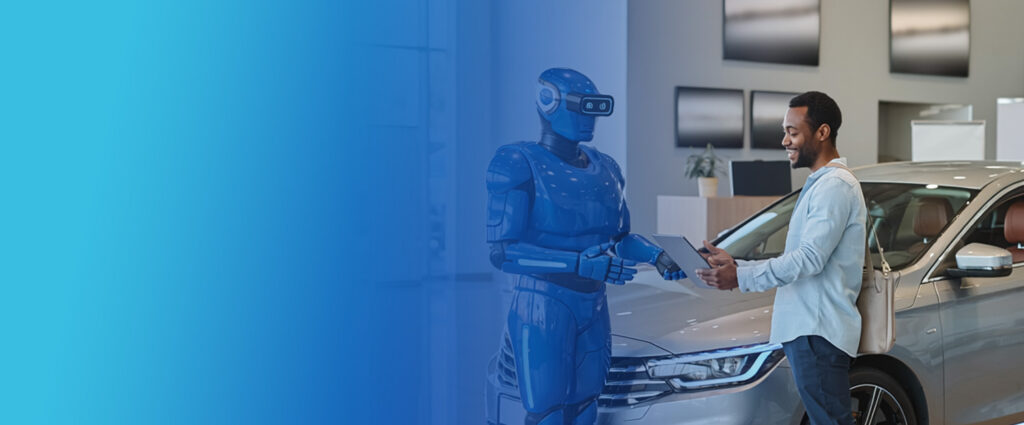
Everywhere you look in the automotive industry, people are talking about AI.
AI sales agents.
AI BDC tools.
AI marketing platforms.
AI service diagnostics.
The conversation usually leads to the same question.
Will AI replace employees in car dealerships?
It is a fair question. But it might also be the wrong one.
AI Is Already in the Dealership
Artificial intelligence is no longer a future concept in automotive retail. It is already showing up in daily operations.
AI tools are helping dealerships qualify internet leads, personalize marketing campaigns, analyze inventory data, and answer customer questions around the clock.
In many cases, these systems are doing the kind of work that used to consume hours of an employee’s day.
- Sorting leads.
- Sending follow-up messages.
- Booking appointments.
Some platforms can even prioritize which customers are most likely to buy based on their behavior online.
The result is simple. Dealership teams can spend less time managing tasks and more time working with customers.
Will Jobs Disappear?
Some will.
Industry surveys show that many dealers expect artificial intelligence to reduce certain dealership roles over the next decade. However, technology rarely eliminates work entirely. Instead, it changes it.
When CRMs arrived in dealerships, they did not eliminate salespeople. They changed how salespeople worked.
When digital retailing appeared, it did not eliminate showrooms. It changed how customers arrived.
AI will likely follow the same pattern.
The Work Will Change
The tasks most likely to disappear are repetitive ones.
- Scheduling appointments
- Answering basic questions
- Sorting leads
- Entering data
These are exactly the types of jobs artificial intelligence is designed to handle.
But dealerships are not factories.
They are human businesses.
Buying a vehicle is emotional.
Servicing a car requires trust.
Negotiating a deal requires judgment.
Those things are still human work.
Across many industries, research shows that while AI replaces some tasks, it increases demand for skills like communication, problem solving, and teamwork.
In other words, the future dealership may not have fewer people. It may have different roles for people.
The Real Question for Dealership Leaders
If AI handles more of the repetitive work, something important changes for managers.
The job of leadership becomes less about managing tasks and more about managing people.
And that brings us to a question the industry does not talk about enough.
How will dealerships manage talent in an AI-enabled workplace?
When technology removes friction from operations, culture becomes the real advantage.
Dealerships will need to focus on employee engagement, recognition, coaching and development, collaboration between departments, and listening to their teams.
Because when machines start doing more of the mechanical work, human motivation becomes even more important.
The Future Dealership Team
The dealership of the future will likely look different from the one we know today.
- AI will handle data analysis faster than any manager.
- It will answer routine questions instantly.
- It will monitor markets and inventory in real time.
But someone still has to build relationships with customers, mentor new employees, solve complicated problems, and create a culture people want to work in.
Those are not technology problems.
They are leadership problems.
The Real Opportunity
Artificial intelligence will absolutely change automotive retail.
But the biggest opportunity may not be efficiency.
It may be focus.
When technology removes some of the operational noise from running a dealership, leaders can spend more time doing the one thing that ultimately determines success.
Building great teams.
And that may turn out to be the most important advantage a dealership can have in the age of AI.
About Werkandme
At Werkandme, we believe the future dealership will rely on technology to run operations but it will rely on people systems to build strong teams.
Because no matter how smart the software becomes, dealerships will still succeed or fail based on the people inside them.